
What Happened
Treasury and the IRS weigh in on §351 ETF conversions
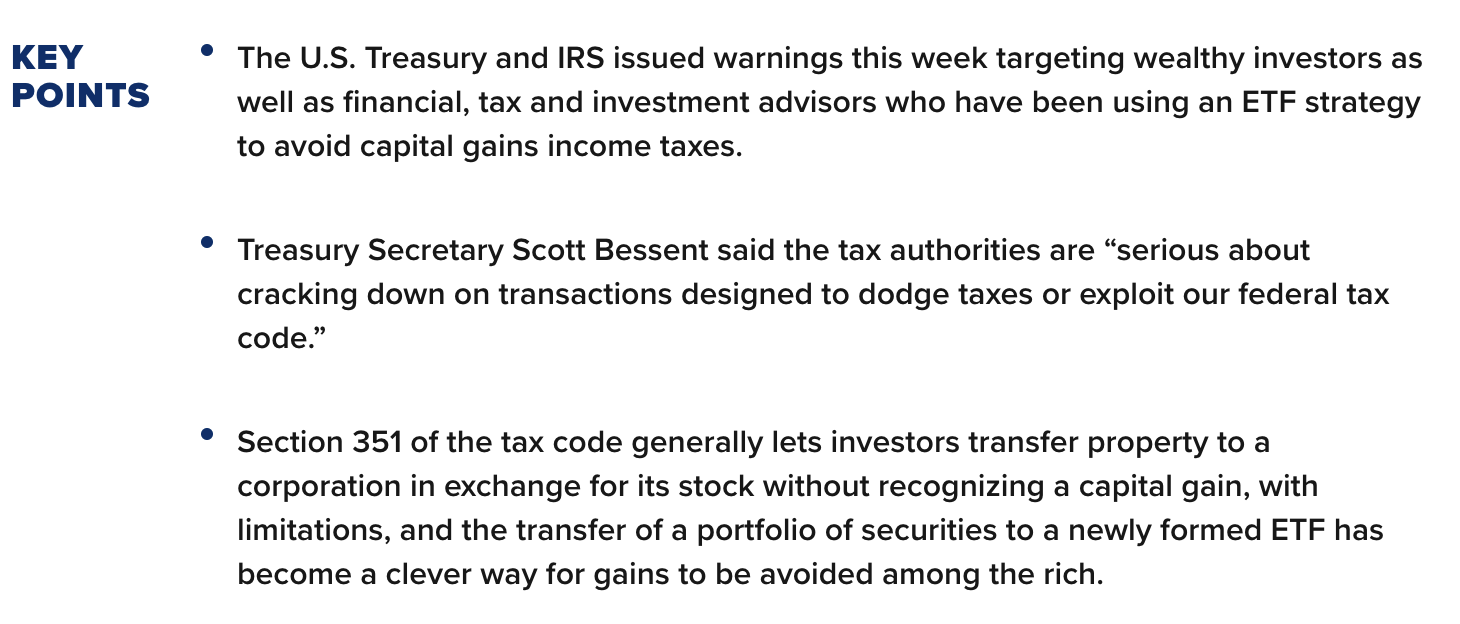
In early October 2026, the U.S. Treasury and the IRS released a revenue ruling and a companion notice on Section 351 exchanges used to seed exchange-traded funds. In a §351 exchange, investors contribute appreciated securities to a newly formed ETF in exchange for ETF shares, usually without recognizing a capital gain at the time of the transfer. As CNBC reported, the guidance is aimed at a specific pattern rather than at §351 exchanges in general.
"“This is really about getting diversification without paying tax.” — Brian Gray, tax partner at Gursey Schneider, quoted by CNBC (Oct. 2, 2026)"
The revenue ruling describes an investor who transfers a portfolio of securities to a new ETF. Under a planned sequence, the ETF distributes the contributed securities soon afterward, and the investor ends up holding a “materially different” portfolio without recognizing the built-in gain. The IRS concluded that this does not qualify for tax deferral. Treasury Secretary Scott Bessent summarized the position on X: “Our message on these conversions is clear: they don't work under existing law.”
What the guidance does not say: The notice states it “does not address, and expresses no view regarding” §351 transactions that seed a new ETF with assets consistent with its investment thesis and that are expected to be retained. Ordinary ETF creations and redemptions are not affected. Comments are requested by October 28, 2026, and further guidance is expected, so details may still change.
Why Diversification
The common thread is a change in what you own
Tax law has long treated a tax-free swap of a concentrated position for a diversified one as something closer to a sale. The investment-company rules in §351(e) exist for exactly this reason, and §721(b) imports the same test for partnerships. The new guidance applies that principle to ETF structures. Practitioners have pointed to three factors that signal concern:
Evidence of a plan
A prearranged series of steps, rather than independent investment decisions made over time.
Quick redemption after seeding
Contributed securities leave the vehicle “shortly after” the transfer. The IRS has not yet defined how short is too short.
A materially different portfolio
The investor walks away holding something economically different from what they put in, typically a broad, diversified basket.
The notice also flags related strategies for closer review, including transfers to partnerships in connection with §351 conversions. The common thread is not the use of a partnership or an ETF. It is using the structure to achieve diversification without recognizing gain.
Where Embark fits
Keep the stock. Put it to work.
No swap into a different portfolio. Enter your ticker and see what income your existing position could generate.
- You stay exposed to the stock you contribute, not a new basket
- Income comes from options on that same position
- No sale, so no capital gains event at contribution
Run the numbers
Live prices · takes under a minute · no obligation
The Spectrum
Same stock, very different levels of scrutiny
Take an investor holding a large, low-basis position in NVIDIA (NVDA). The table below sketches how the level of concern changes as the end result moves further from the original stock. This is an informational summary, not a legal conclusion about any specific arrangement.
| Transaction | End result | Level of IRS concern |
|---|---|---|
| NVDA → partnership that primarily holds NVDA | Same exposure | Much lower |
| NVDA → partnership → NVDA + NVDA options + operating cash | Same exposure, plus income | Much lower |
| NVDA → partnership → diversified portfolio | Different exposure | Higher |
| NVDA → partnership → ETF → broad portfolio | Materially different | Specifically flagged in the notice |
| Diversified stocks → ETF that keeps those stocks | Same holdings | Notice expressly reserves judgment |
| Diversified stocks → ETF → quick redemption → different holdings | Materially different | Taxable under the new revenue ruling |
$10M NVDA position, $1M cost basis: two end states
Swapped into a diversified basket
$9M
Built-in gain the IRS may treat as realized
If the sequence is recharacterized, the gain could be taxed as though the stock were sold. At a combined ~37% rate in California, that's roughly $3.3M.
Kept as NVDA exposure
$0
Gain recognized on contribution
Continued concentration and genuine economic exposure to the contributed stock are central to the §721 analysis. The diversification trigger is never pulled.
What It Means for You
The trade-off between diversification and deferral
For many holders of concentrated stock, the goal was never diversification for its own sake. It was access to value: income, liquidity, or some protection, without a large tax bill on a sale. The guidance makes the trade-off clearer. Tax-free diversification now faces direct scrutiny, while strategies that keep you invested in the stock you already own are built on a different foundation.
Do
- Ask whether a structure leaves you with the same economic exposure you contributed
- Read the full notice and revenue ruling with your tax advisor
- Watch for follow-up guidance after the October 28 comment deadline
- Separate the goal (income, liquidity) from the method (diversification)
Don't
- Assume every §351 or §721 transaction is now suspect, since the guidance is narrow
- Rely on a prearranged sequence that ends in a materially different portfolio
- Treat “shortly after” as safe until the IRS defines it
- Make decisions based on headlines alone
How Embark Differs
Income from your stock, without swapping it
Embark was designed around the principle the guidance reinforces. Investors contribute appreciated stock to an Embark SPV under IRC §721. The SPV keeps that same stock and runs an options-based income strategy on it. Contributors stay economically exposed to the stock they contributed rather than being moved into a different portfolio.
| Diversification via §351 ETF | Embark §721 income strategy | |
|---|---|---|
| What you hold afterward | A materially different, diversified portfolio | Exposure to the same stock you contributed |
| Primary goal | Diversify without recognizing gain | Generate income on the existing position |
| Focus of the new guidance | Yes, directly addressed | Not the pattern described |
| Typical minimum | Often $25M+ in appreciated stock | Accessible to accredited investors |
| Income | None from the structure itself | Targeted ~10%+ annually |
No structure is free of tax risk, and the IRS can issue further guidance. Embark reviews new rulings with tax counsel as they are released. Our current reading is that the October 2026 guidance does not address partnerships that retain the contributed stock. Speak with your own tax advisor about your situation. For the broader picture, see exchange funds vs. Embark and how to monetize appreciated stock without selling.
Monetize Appreciated Stock Series
8 of 8
Keep Your Stock. Earn Income.
Generate Income on Your Appreciated Stock — Without Selling or Diversifying
Embark's §721 structure keeps you exposed to the stock you contribute, so you aren't swapping it for a different portfolio. The strategy aims to generate income on that same position without a sale.